The JournalMyth Check
Is 30 Grams of Protein Per Meal Really the Limit?
A carefully controlled 2023 study found that 100 grams of milk protein after training raised muscle protein synthesis more, and for longer, than 25 grams. It weakens the case for a per-meal ceiling, but says less about how to structure a day of eating than the headlines suggest.
- By
- ScalePod Editorial
- Published
- Reading time
- 10 min read
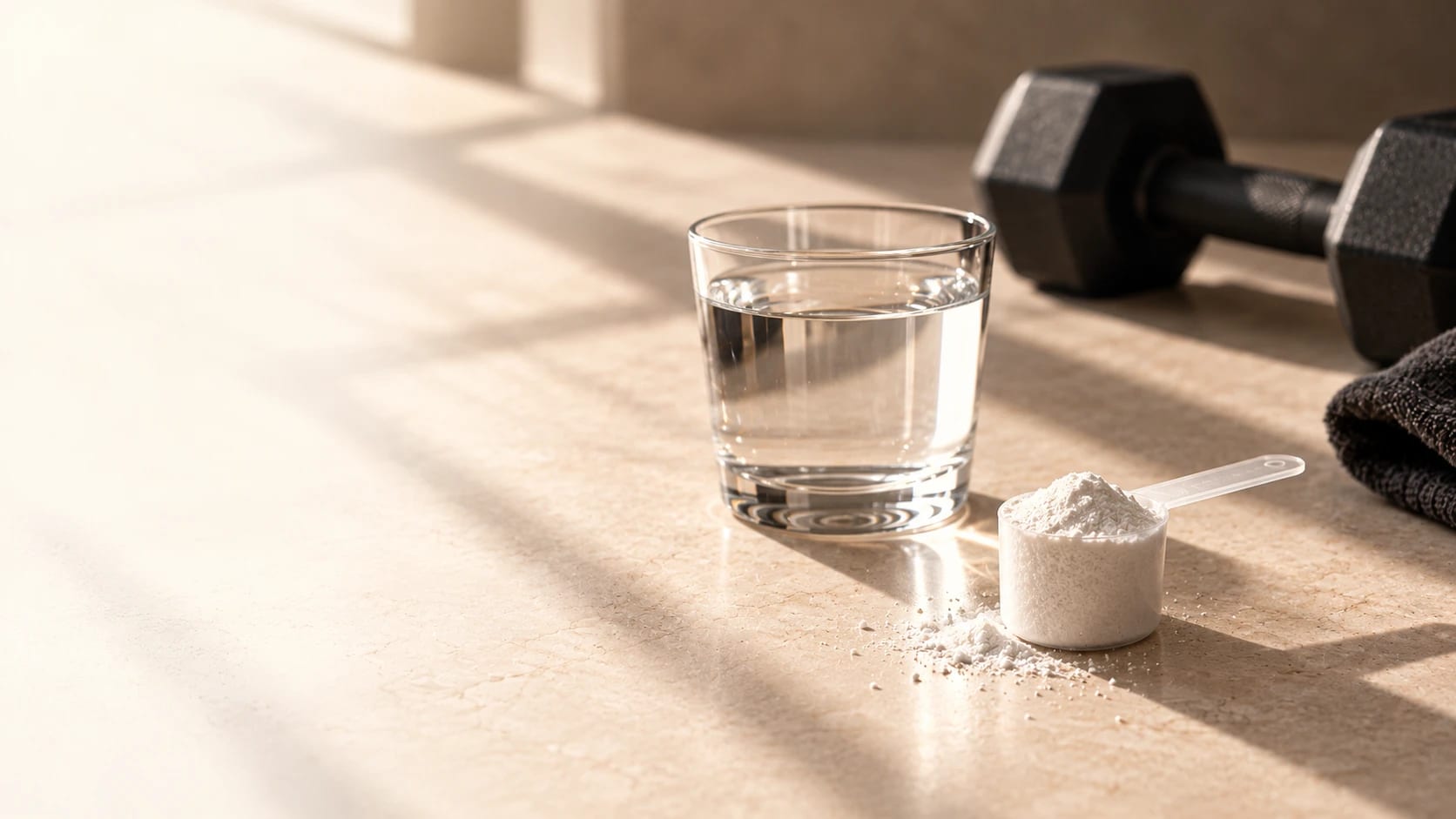
Twelve hours after drinking 100 grams of milk protein, the young men in a Maastricht trial published in 2023 were still absorbing it. By the final muscle biopsy, only about half of the dose’s amino acids had reached their circulation, and that share was still rising; so was the cumulative amount built into their muscle protein 1.
That is an awkward fact for one of gym nutrition’s most durable rules: muscle can use only 20 to 30 grams of protein at a sitting, and the rest is burned off. The study, by Jorn Trommelen and colleagues, appeared in Cell Reports Medicine under a title claiming the anabolic response to protein has no upper limit in magnitude and duration 1. The title is bolder than the data, but the data deserve a close read.
The research at a glance
Trommelen et al., Cell Reports Medicine
- Study type
- Randomized, double-blind, placebo-controlled trial (acute tracer study)
- Sample
- 36 healthy, recreationally active young men (12 per group)
- Published
- 2023
- Key finding
- After a whole-body resistance session, 100 g of milk protein produced higher myofibrillar protein synthesis over 12 hours than 25 g, which in turn exceeded placebo. Rates were about 20% higher in hours 0–4 and, by the authors’ estimate, about 40% higher in hours 4–12 1.
- Important limitation
- A 12-hour measurement of synthesis after a single drink taken after an overnight fast: it cannot show long-term muscle gain or test how protein should be spread across a day.
Where the ceiling came from
The limit grew out of careful dose-response work. In 2009, Moore and colleagues gave six young men 0 to 40 g of whole egg protein after intense leg exercise; synthesis over four hours was maximally stimulated at 20 g 2. In 2014, Witard and colleagues gave 48 resistance-trained men 0, 10, 20 or 40 g of whey isolate after one-legged exercise, judged 20 g sufficient for maximal stimulation, and reported that 40 g increased amino acid oxidation and urea production 3. In both, the ceiling rested on 40 g not producing a detectably larger response than 20 g in modest samples: an absence of evidence, not proof of a plateau.
The number has since drifted. Trommelen’s paper describes prevailing advice as no more than 20–25 g per main meal 1. The 2017 position stand of the International Society of Sports Nutrition (ISSN) suggests about 0.25 g/kg, or 20–40 g, per serving 4, and a 2024 review by Antonio and colleagues in the society’s journal says 20–30 g has been posited as adequate 5. The “30 grams” in our headline is shorthand, not an agreed figure.
Even in short windows, the ceiling was not absolute. In a 2016 crossover trial of 30 resistance-trained men, 40 g of whey after a whole-body session produced more myofibrillar synthesis over five hours than 20 g (p = 0.005), a difference already evident within three hours. The authors suggested the larger amount of muscle trained might explain it, though they could not pin down the cause 6. None of these studies looked beyond five hours or above 40 g.
What the trial tested
Trommelen and colleagues asked whether the anabolic response to protein has an upper limit in size or duration. They compared a meal-sized 25 g with 100 g, the most they considered feasible in one meal, and a placebo, over 12 hours 1.
The trial was randomized, double-blind, placebo-controlled and prospectively registered, with three parallel groups of 12 1. The 36 participants were healthy, recreationally active men with a mean age of 25 (eligibility was 18 to 40) who exercised one to three times a week; none was described as resistance-trained, and no women took part 1.
After an overnight fast, each man completed a 60-minute whole-body session: a cycling warm-up, then four sets each of leg press, leg extension, lat pulldown and chest press, the first at 65% of one-repetition maximum and the rest at 80% to volitional fatigue. He then drank 800 mL of water containing 0, 25 or 100 g of protein from milk protein concentrate, roughly 80% casein and 20% whey 1. It was a single drink, not a mixed meal, and the methods describe no other food over the 12 hours.
The protein came from a cow infused with labeled amino acids, so it carried a built-in tracer. With intravenous tracers, this let the team follow dietary amino acids into blood, plasma proteins and muscle, separately from those released by breakdown. Thigh biopsies were taken at 0, 4, 8 and 12 hours; the pre-registered primary outcome was myofibrillar protein synthesis over 12 hours 1.
What it found
Myofibrillar protein synthesis over 12 hours rose with dose: 100 g exceeded 25 g, which exceeded placebo, each difference statistically significant 1. Compared with 25 g, 100 g produced rates about 20% higher in the first four hours and, by the authors’ estimate, about 40% higher from hours 4 to 12 1. Window by window, the picture is less tidy: in hours 4 to 8, 25 g no longer differed detectably from placebo while 100 g exceeded both; in hours 8 to 12, 100 g still beat placebo, but its margin over 25 g was not significant 1.
The blood data agree. Plasma amino acids stayed above placebo for about five hours after 25 g and all 12 hours after 100 g, and the release of dietary amino acids into the circulation leveled off with 25 g but not with 100 g 1.
Where the protein went over 12 hours, as reported by Trommelen et al. 1
| Measure | 25 g | 100 g |
|---|---|---|
| Dietary amino acids appearing in the circulation | 16 ± 1 g | 53 ± 7 g |
| Same, as a share of the dose | 66% | 53% |
| Dietary amino acids built into skeletal muscle protein | 17–18% of the dose | 13 g (13% of the dose) |
| Dietary share of amino acids built into myofibrillar protein | 9% | 27% |
Amino acid oxidation rose with intake, but the authors report it was negligible relative to the rise in whole-body protein synthesis, and whole-body net protein balance correlated strongly with intake 1. That runs against the idea that the excess is simply burned.
Markers of anabolic signaling, including the mTOR pathway, showed no detectable effect of protein feeding 1. But the first post-drink biopsy came at four hours, and the authors describe the molecular response to protein as short-lived, so an early response could have been missed. Still, synthesis stayed elevated where signaling markers did not differ, weakening the inference that a signaling plateau means a synthesis plateau.
How far the result reaches
This is a one-day study of synthesis rates. It measured no muscle size, lean mass or strength, so it cannot show that 100 g servings build more muscle. The authors note that the body may adapt over time, for example by raising oxidation when large amino acid surges become routine, or by compensating in a later fasted period 1.
Only two protein doses were tested, plus placebo, so the study cannot say whether the response flattens between 25 and 100 g or what happens above 100 g; “no upper limit” is an interpretation two doses cannot establish. Sampling also stopped at 12 hours with several responses still elevated, which is why the authors call their cumulative estimates minimal 1.
The setting is narrow, and the authors say they do not know whether the results extrapolate to other populations or conditions 1. In a published commentary, Witard and Mettler stress that the volunteers were not resistance-trained and point to newer work suggesting the finding may not hold for resistance-trained young women 7. The protein was slow-digesting and casein-dominant, taken in water, fasted, after a whole-body session; the authors argue that faster proteins would behave similarly, but that was not tested 1.
Twelve men per group is a small sample, and we found no sample-size calculation in the paper. Among the muscle measures, only the pre-registered primary outcome separated all three groups significantly; several secondary measures did not separate 25 g from placebo, and one separated no groups at all 1. A missing pairwise difference means the study could not resolve it, not that the doses were equivalent. The authors also note that tracer recycling and their choice of precursor pool may make absolute rates slight underestimates 1.
Because doses were randomized and blinded, the higher synthesis rates can reasonably be attributed to dose here; what remains unproven is the link to long-term outcomes. One author is an employee of the dairy company FrieslandCampina; the paper states the company had no role in funding, data collection and analysis, or manuscript preparation 1.
Daily totals versus single meals
The authors read their results broadly, writing that the data explain why larger, less frequent meals are a viable alternative to smaller, more frequent ones 1. But meal frequency was not tested: the trial compared one 25 g drink with one 100 g drink, which also supplied four times the protein, not 100 g at once with 100 g spread across the day.
Witard and Mettler welcome the advance but caution against reading it as grounds for dismissing protein distribution 7. The original authors replied that their trial was not designed to test distribution but undercuts a central rationale for it, the belief that a single meal’s response is capped and brief, and that current evidence is insufficient to recommend any particular pattern 8.
The best-known acute test of spacing points the other way. In a 2013 study, 24 trained men (eight per group) took 80 g of whey over 12 hours of post-exercise recovery as eight 10 g, four 20 g or two 40 g doses; four 20 g doses produced more synthesis than either alternative 9. That trial used fast-digesting whey and no dose above 40 g, so it does not refute the 2023 result, but it shows spacing can change 12-hour synthesis rates. Trommelen and colleagues counter that most distribution studies have found no effect on synthesis or muscle mass 8.
We found few long-term trials in trained lifters. In a 2025 study, resistance-trained men were randomized to three or five high-protein meals a day, at similar total intake, for eight weeks of training. Both groups gained lean mass, muscle size and strength, with no significant difference 10. With only 18 of 32 finishing, that null result cannot establish equivalence.
Total daily intake has firmer support. A 2018 meta-analysis of 49 randomized trials (1,863 participants, at least six weeks of resistance training) found that protein supplementation added 0.30 kg (95% CI 0.09 to 0.52) to gains in fat-free mass, which includes water and organs as well as muscle. In a breakpoint analysis of 42 study arms, gains appeared to level off around 1.62 g/kg per day (95% CI 1.03 to 2.20), though that model was not statistically significant (p = 0.079); given the wide interval, the authors suggest about 2.2 g/kg may be prudent for those seeking maximal gains 11. Schoenfeld and Aragon suggest about 0.4 g/kg per meal across at least four meals 12.
What this means at the table
The evidence supports a revision, not a reversal: stop treating 25 to 30 g as a cap. The idea that everything past it is oxidized is not supported, at least after training 1, and a 2024 review concludes that the upper limit for a single meal is not known 5. Nor does the trial justify the opposite rule, that two very large protein meals equal four moderate ones for growth; that question remains open 78910.
What we know
- After whole-body resistance exercise, 100 g of milk protein produced more myofibrillar protein synthesis over 12 hours than 25 g, which exceeded placebo 1.
- Four-hour windows miss part of a large dose’s effect: in hours 4 to 8, 25 g no longer differed detectably from placebo, while 100 g stayed elevated 1.
- Only about half of the 100 g reached the circulation within 12 hours, and oxidation was small relative to the rise in protein synthesis 1.
- In a five-hour crossover study of resistance-trained men, 40 g of whey produced more myofibrillar synthesis than 20 g after whole-body training 6.
What we don’t know
- Whether a longer response after one drink becomes more muscle over months 1.
- What happens between 25 and 100 g, above 100 g, or beyond 12 hours 1.
- Whether the findings hold for trained lifters, women, older adults, whole-food meals, faster proteins or meals away from training 17.
- Whether fewer, larger protein meals match evenly spaced ones over the long term; evidence is insufficient to recommend a pattern 8, and trials in trained lifters are small 10.
The practical takeaway
- There is no need to cap a post-training meal at 30 g for fear the rest is wasted: after whole-body training in young men, the extra protein was mostly not oxidized 1, and no hard per-meal limit has been shown 5.
- Put total daily protein first. In supplementation trials, fat-free mass gains appeared to plateau near 1.6 g/kg per day, though that breakpoint was not statistically significant 11.
- Spreading protein every three to four hours, as the ISSN advises, is a sensible default, not a proven requirement 4812. If your next meal is more than four or five hours away, Trommelen and colleagues suggest at least 40 g 8.
- If you manage a medical condition, discuss substantial changes in protein intake with your clinician.
The 30-gram rule was not invented; it was a reading taken through a narrow window. Measure for four hours after modest doses and the response can look capped. Measure for 12 hours after 100 g and dietary amino acids are still arriving in the blood and still being built into muscle. Adequately powered trials that would settle the practical question are still missing: large and small protein meals compared head to head, in trained men and women, over months.
Written by ScalePod Editorial from the sources listed below. This article is general information for healthy, trained adults, not medical or dietary advice.
References
1. Trommelen J, van Lieshout GAA, Nyakayiru J, et al. The anabolic response to protein ingestion during recovery from exercise has no upper limit in magnitude and duration in vivo in humans. Cell Reports Medicine. 2023;4(12):101324, 2023. doi.org/10.1016/j.xcrm.2023.101324 (opens in a new tab)
2. Moore DR, Robinson MJ, Fry JL, et al. Ingested protein dose response of muscle and albumin protein synthesis after resistance exercise in young men. American Journal of Clinical Nutrition. 2009;89:161–168, 2009. doi.org/10.3945/ajcn.2008.26401 (opens in a new tab)
3. Witard OC, Jackman SR, Breen L, et al. Myofibrillar muscle protein synthesis rates subsequent to a meal in response to increasing doses of whey protein at rest and after resistance exercise. American Journal of Clinical Nutrition. 2014;99:86–95, 2014. doi.org/10.3945/ajcn.112.055517 (opens in a new tab)
4. Jäger R, Kerksick CM, Campbell BI, et al. International Society of Sports Nutrition Position Stand: protein and exercise. Journal of the International Society of Sports Nutrition. 2017;14:20, 2017. doi.org/10.1186/s12970-017-0177-8 (opens in a new tab)
5. Antonio J, Evans C, Ferrando AA, et al. Common questions and misconceptions about protein supplementation: what does the scientific evidence really show? Journal of the International Society of Sports Nutrition. 2024;21(1):2341903, 2024. doi.org/10.1080/15502783.2024.2341903 (opens in a new tab)
6. Macnaughton LS, Wardle SL, Witard OC, et al. The response of muscle protein synthesis following whole-body resistance exercise is greater following 40 g than 20 g of ingested whey protein. Physiological Reports. 2016;4(15):e12893, 2016. doi.org/10.14814/phy2.12893 (opens in a new tab)
7. Witard OC, Mettler S. The Anabolic Response to Protein Ingestion During Recovery From Exercise Has No Upper Limit in Magnitude and Duration In Vivo in Humans: A Commentary. International Journal of Sport Nutrition and Exercise Metabolism. 2024;34(5):322–324, 2024. doi.org/10.1123/ijsnem.2024-0041 (opens in a new tab)
8. Trommelen J, Holwerda AM, van Loon LJC. Protein Intake Distribution: Beneficial, Detrimental, or Inconsequential for Muscle Anabolism? Response to Witard & Mettler. International Journal of Sport Nutrition and Exercise Metabolism. 2024;34(5):325–328, 2024. doi.org/10.1123/ijsnem.2024-0107 (opens in a new tab)
9. Areta JL, Burke LM, Ross ML, et al. Timing and distribution of protein ingestion during prolonged recovery from resistance exercise alters myofibrillar protein synthesis. Journal of Physiology. 2013;591(9):2319–2331, 2013. doi.org/10.1113/jphysiol.2012.244897 (opens in a new tab)
10. Tavares H, Roschel H, Felício V, et al. Effects of daily protein intake frequency during 8 weeks of resistance training on lean mass and strength adaptations: a randomized non-controlled clinical trial. Journal of Sports Medicine and Physical Fitness. 2025;65(10):1337–1345, 2025. doi.org/10.23736/S0022-4707.25.16698-X (opens in a new tab)
11. Morton RW, Murphy KT, McKellar SR, et al. A systematic review, meta-analysis and meta-regression of the effect of protein supplementation on resistance training-induced gains in muscle mass and strength in healthy adults. British Journal of Sports Medicine. 2018;52:376–384, 2018. doi.org/10.1136/bjsports-2017-097608 (opens in a new tab)
12. Schoenfeld BJ, Aragon AA. How much protein can the body use in a single meal for muscle-building? Implications for daily protein distribution. Journal of the International Society of Sports Nutrition. 2018;15:10, 2018. doi.org/10.1186/s12970-018-0215-1 (opens in a new tab)