The JournalBody Composition
The Creatine Illusion: When Lean Mass Isn’t New Muscle
In a 2025 trial, creatine added about half a kilogram of scanned lean mass in a single week, before anyone had trained. That does not make creatine an illusion, but it does change how a body-composition report should be read.
- By
- ScalePod Editorial
- Published
- Reading time
- 11 min read
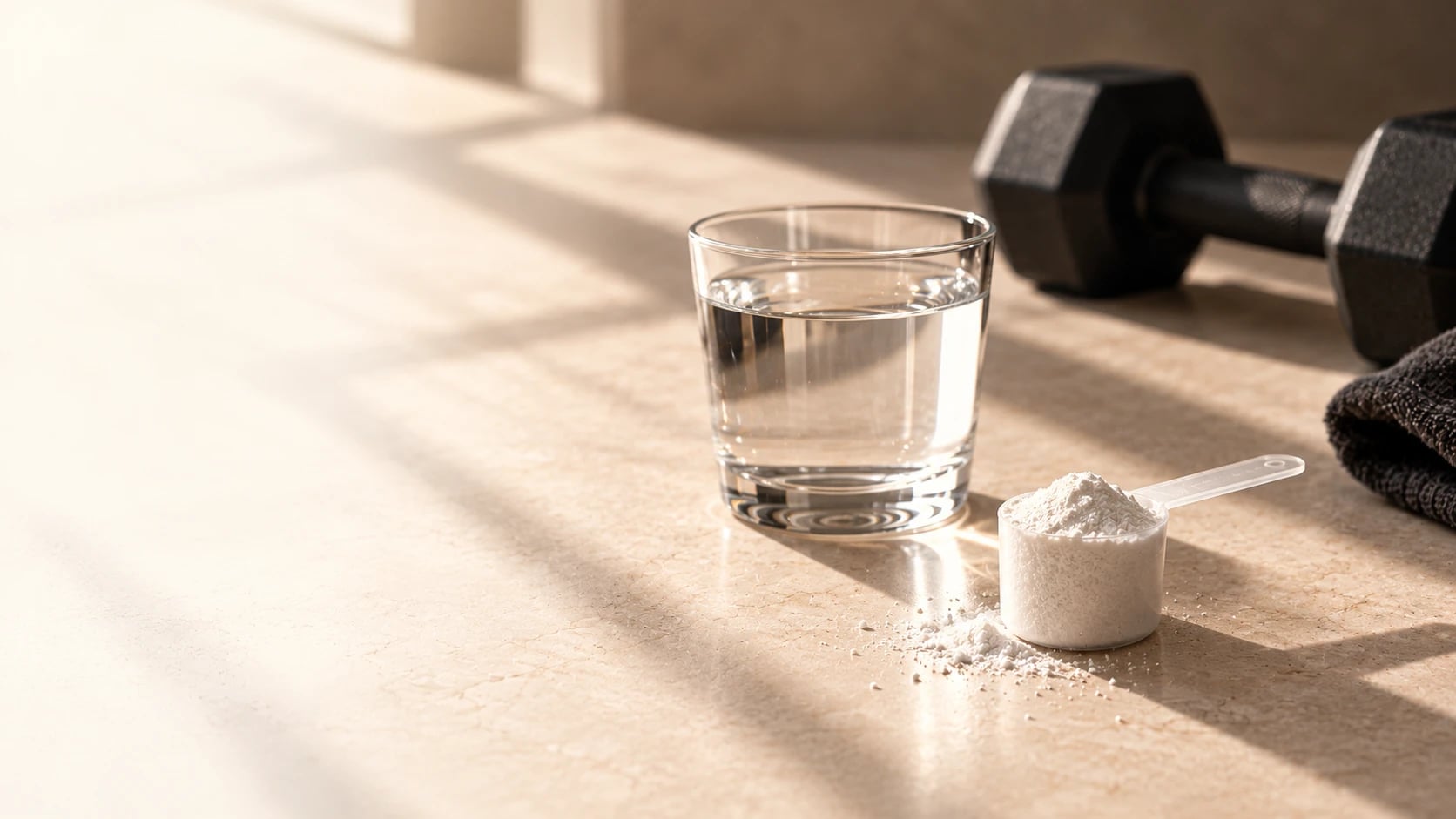
A DXA scanner never sees muscle. It divides the body into fat, bone mineral and everything else, and reports the remainder as lean mass: contractile protein, but also water, glycogen, organs and gut contents. Anything that changes how much water muscle holds can move that number without any new tissue being built.
Creatine is the obvious test case. A 2025 randomized trial gave untrained adults creatine for a week before they started lifting 1. The creatine group came out about half a kilogram ahead on lean mass before anyone had trained; over the next 12 weeks of training, the two groups gained similar amounts on average.
That is not proof that creatine’s lean-mass benefit is water. It is a reason to keep lean mass, muscle, body weight and performance apart.
The research at a glance
Desai et al., Nutrients
- Study type
- Randomized controlled trial (single-blind, no placebo)
- Sample
- 63 untrained adults (34 women, 29 men); 54 completed training
- Published
- 2025
- Key finding
- After one week of 5 g/day creatine without exercise, the creatine group gained about 0.5 kg more DXA lean mass than controls (0.51 vs. 0 kg; p = 0.03). Over the next 12 weeks of training, gains did not differ significantly (2.24 vs. 2.11 kg; p = 0.71), though the trial could not rule out a meaningful difference 1.
Desai et al., Journal of Strength and Conditioning Research
- Study type
- Systematic review and meta-analysis
- Sample
- 12 studies
- Published
- 2024
- Key finding
- In adults under 50, creatine plus resistance training increased lean body mass by 1.14 kg (95% CI 0.69 to 1.59) more than training alone 2.
- Important limitation
- Lean-mass outcomes cannot separate water from muscle tissue, so the pooled gain is not a direct measure of hypertrophy 5.
Burke et al., Nutrients
- Study type
- Systematic review with meta-analysis
- Sample
- 10 studies, 44 outcomes
- Published
- 2023
- Key finding
- On direct imaging of muscle, the pooled estimate showed a very small advantage for creatine in muscle size: SMD 0.11 (95% credible interval −0.02 to 0.25) 5.
- Important limitation
- The interval crosses zero, only two of the 10 studies involved resistance-trained participants, and no trunk muscles were imaged 5.
The question behind the trial
Meta-analyses agree that creatine plus resistance training adds lean mass beyond training alone: 1.14 kg (95% CI 0.69 to 1.59) across 12 studies in adults under 50, in a 2024 analysis by largely the same research group 2, and 1.10 kg (95% CI 0.56 to 1.65) in the resistance-training subgroup of a 2022 meta-analysis of 35 randomized trials 3.
Pooled estimates cannot say when the extra mass appears. In a conventional trial, supplement and training start together, so any quick, supplement-only change is credited to the combination. The 2025 authors note that none of the trials in the 2022 meta-analysis 3 used a wash-in period, and propose that this timing may partly inflate pooled gains 1: a hypothesis, not an established finding. Their question: does 5 g of creatine a day change DXA lean mass before training starts, and does it add anything once training begins?
How the study was run
The single-blind randomized trial (outcome assessors and analysts were masked; participants were not) was part of a larger, prospectively registered study of the gut microbiome and training-induced muscle growth 14. Participants were healthy, untrained adults aged 18 to 50 with a BMI of 30 or below and no resistance training in the previous year. Sixty-three were included in the wash-in analysis (34 women, 29 men; mean age 31): 30 on creatine and 33 controls 1.
The creatine group took 5 g of creatine monohydrate a day for all 13 weeks, with no loading phase and no supervision of intake. Controls took nothing, not even a placebo. Both groups were asked to avoid exercise for the first seven days, then completed the same supervised program: three full-body sessions a week for 12 weeks, four sets of 6–12 repetitions per exercise 1.
Whole-body and regional lean and fat mass were measured by DXA (GE Lunar iDXA) at baseline, after the no-exercise week and after training: early in the morning, after an 8-hour fast, with no exercise for 12 hours and the bladder emptied. Test–retest reliability was excellent (ICC 0.996), with a standard error of measurement of 0.59 kg for lean mass. Water intake and hydration were neither controlled nor recorded, and neither body water nor muscle creatine was measured 1.
Each phase was analyzed separately, adjusted for lean mass at its start. The comparison by sex was post hoc, and there was no advance power calculation for the creatine question. Fifty-four people completed training (26 on creatine, 28 controls) 1.
Methods explainer: what each measure captures
DXA lean mass lumps together all tissue that is neither fat nor bone mineral; a 2023 review calls it an imprecise proxy for skeletal muscle 5. In trained male cyclists, glycogen loading substantially raised DXA lean-mass estimates over days when little change in muscle protein was likely. Creatine loading alone had a likely trivial effect on DXA lean mass, but muscle creatine itself barely rose in that condition (scans followed a drop to 3 g a day), so that null result is weak evidence 6.
Fat-free mass usually includes bone mineral as well. Bioelectrical impedance (BIA) infers composition from the body’s water-dependent electrical properties, so it is itself sensitive to hydration. Hypertrophy needs a direct measure: ultrasound, MRI, CT or biopsy.
What the scans showed
After the no-exercise week, the creatine group had gained about 0.5 kg more lean mass than the controls (0.51 vs. 0 kg; p = 0.03), mostly in the trunk (0.32 vs. −0.10 kg; p = 0.01) 1. Arm and leg lean mass, and fat mass, showed no significant differences. Body weight rose by 0.40 kg on creatine and was unchanged on average in controls; no test of that difference was reported.
Change in DXA whole-body lean mass by phase, Desai et al. 2025 1
| Phase | Creatine, 5 g/day | Control, no supplement | Between-group p |
|---|---|---|---|
| Wash-in: 7 days, no exercise | +0.51 kg (n = 30) | 0 kg (n = 33) | 0.03 |
| Resistance training: 12 weeks | +2.24 kg (n = 26) | +2.11 kg (n = 28) | 0.71 |
| Whole study: 13 weeks | +2.78 kg (n = 26) | +2.04 kg (n = 28) | 0.05 |
In the reported means, most of the 0.74 kg whole-study gap had already opened during the no-exercise week 1.
A post hoc split found the first-week difference (0.55 vs. −0.03 kg; p = 0.04) and a significant whole-study advantage (2.60 vs. 1.40 kg; p = 0.01) in women, but not in men 1. With roughly 12 to 18 people per sex in each arm (the paper’s withdrawal figures do not fully reconcile), no tracking of the menstrual cycle, and a 2022 meta-analysis that found the opposite pattern 3, this is a lead, not a finding to act on.
The authors conclude that creatine’s apparent extra benefit was likely driven by short-term effects of supplementation on the lean-mass measurement, and offer trunk fluid or stomach contents as plausible explanations 1. Neither was measured. Their suggestion that more than 5 g a day may be needed to add to training gains is untested; only one dose was studied 1.
How far the result goes
Causation, and what it covers
Random allocation lets the first-week difference be attributed to being assigned creatine. Without a placebo, that may include expectancy effects or behavior that came with taking the powder, such as drinking more water. Randomization also says nothing about what the extra half-kilogram was 1.
An effect inside the error band
The first-week difference (0.51 kg) is smaller than the scanner’s standard error of measurement (0.59 kg). The authors acknowledge this and argue that the error applies to both groups alike 1. That is fair for a group comparison, but one small trial at p = 0.03 is suggestive, not definitive.
What p = 0.71 does not mean
The training-phase result is not evidence that creatine added nothing once lifting began. The paper reports no confidence interval, but working back from its reported difference (0.13 kg) and p-value gives a 95% interval of roughly −0.6 to +0.8 kg (our approximate calculation; because the paper’s p-value comes from an adjusted model, the true interval may be wider) 1. That is compatible with no added benefit, and with a training-phase gain of 0.8 kg or more: a large share of the roughly 1 kg pooled estimates, which also include any pre-training shift 23.
What the study could not see
The trial did not image muscle, so it cannot show that the extra lean mass was not muscle, only that it appeared before training. It reported no strength data, although strength testing is a registered secondary outcome of the parent trial 4. Participants were untrained, so the results may not transfer to experienced lifters, and the dose was 5 g a day without loading. The International Society of Sports Nutrition (ISSN) notes that lower daily doses raise muscle creatine gradually, over about 28 days at 3 g a day 7, so stores were probably only partly raised after one week. Some figures differ between the abstract, flow diagram and tables (63 vs. 64 randomized, for example). The study had no external funding; the creatine came through a supplement company’s sponsorship of the corresponding author 1.
The wider evidence
Lean mass: a consistent signal
A GRADE-assessed meta-analysis of 143 randomized trials found that creatine increased body mass by 0.86 kg (95% CI 0.76 to 0.96) and fat-free mass by 0.82 kg (95% CI 0.57 to 1.06; significant only with resistance or combined training), both with high certainty 8. Its authors note that some of the gain may be water, which too few trials measured to tell apart. Without exercise, the 2022 meta-analysis found no significant effect (0.03 kg), but its 95% CI of −0.65 to 0.70 kg 3 includes the 2025 wash-in result.
Muscle: smaller and less certain
Restricted to direct imaging, the effect shrinks. Across 10 studies using ultrasound or peripheral quantitative CT, the pooled standardized mean difference was 0.11 (95% credible interval −0.02 to 0.25), which the authors describe as a very small effect favoring creatine; in young adults it was 0.23 (0.01 to 0.44) 5. They suggest the gap with whole-body lean mass may partly reflect extracellular fluid, or growth in tissues the imaging did not cover, such as bone. Unimaged muscle they consider an unlikely explanation, given similar effects across the muscles studied, though trunk muscles have yet to be examined 5. The fair summary is neither “builds no muscle” nor “proven to build muscle.”
Water: real, and clearest early
In 32 resistance-trained men and women, a week of loading at 25 g a day followed by 5 g a day raised muscle creatine, body mass and total body water, measured by dilution methods, with no significant shift in its split between the inside and outside of cells; total body water also rose on placebo, by less 9. Without any training, 10 days of creatine increased fat-free mass, total body water and body weight in 12 young men 10. The ISSN describes short-term fluid retention of about 0.5–1.0 L with loading 7. Most of this evidence involves loading, not 5 g a day.
Acute and long-term effects differ. A 2021 review says water retention appears to be the most common adverse effect in the first several days, when both extracellular and intracellular water have been seen to rise. Findings over longer periods are mixed: several 5–10-week training studies found no rise in total body water, and in one eight-week study in which intracellular water did rise, its ratio to muscle mass held steady 11. A small body of stable-isotope research has not found that short-term creatine raises muscle protein synthesis 12, which makes new contractile tissue a less likely explanation for a first-week jump (an inference, not a measurement).
Performance: a separate question
The 2025 trial reported no performance outcomes. A 2024 meta-analysis of 23 studies in adults under 50 found that creatine plus resistance training increased upper-body strength by 4.43 kg and lower-body strength by 11.35 kg more than placebo; the gains were significant in men but not in women, the subject of only two studies 13. After loading, the ISSN reports that high-intensity or repetitive exercise performance generally improves by 10–20%, depending on how much muscle phosphocreatine rises 7.
What to do with this
The practical lesson is about timing. A scan taken before creatine and one taken in its first weeks measure muscle holding different amounts of creatine, and possibly water. Treat that change as a new baseline rather than as evidence of new muscle. Without loading, muscle stores rise more slowly 7, so the shift may stretch over weeks rather than days; the right wash-in length is still unstudied 1.
Standardize scan conditions: the 2025 protocol is a sensible starting point, ideally adding consistent fluid intake, which that trial did not control 1. None of this is a reason to drop creatine: its strength benefits are well supported, at least in men 713, its effect on imaged muscle is small but probably positive 5, and its water effect is clearest in the first days 11. People with a medical condition should check with a clinician before starting.
What we know
- Creatine increases measured lean or fat-free mass by roughly 0.7 to 1.1 kg in pooled estimates, mainly with resistance training; without exercise, pooled estimates were not significant 238.
- DXA lean mass includes water, glycogen and other non-fat tissue; it is not a direct measure of muscle 56.
- Creatine can raise total body water in the short term, especially with loading 7910.
- Lean-mass gains measured from a pre-supplement baseline can include changes that appear before any training 110.
- Creatine plus training improves strength, most clearly in men under 50 13.
What we don’t know
- What the first-week difference in the 2025 trial consisted of: water, glycogen, gut contents and measurement noise were not separated 1.
- Whether creatine adds lean mass during training beyond that early shift; the trial was too small to tell 1.
- How much of the pooled lean-mass effect is new muscle; direct imaging suggests a smaller, less certain effect 5.
- Whether women and men respond differently; the available evidence conflicts 1313.
- How long the early phase lasts, and whether it depends on dose or loading.
The practical takeaway
- Treat body-composition changes in the first weeks of creatine as provisional, especially after loading or when measured by BIA.
- Re-baseline after loading, or after several weeks on a consistent daily dose, and compare scans taken under the same conditions.
- Judge creatine by training performance and long-run trends, not by the first scan or the scale.
The illusion in the title is a narrow one. Creatine’s effects are real; what can mislead is the precision read into a single body-composition number early in supplementation. Whether its remaining lean-mass advantage is muscle, and how much, is still open; trials with body-water and direct muscle measures can answer that.
Written by ScalePod Editorial from the sources listed below. This article is general information for healthy, trained adults, not medical or dietary advice.
References
1. Desai I, Pandit A, Smith-Ryan AE, et al. The Effect of Creatine Supplementation on Lean Body Mass with and Without Resistance Training. Nutrients 17(6):1081, 2025. doi.org/10.3390/nu17061081 (opens in a new tab)
2. Desai I, Wewege MA, Jones MD, et al. The Effect of Creatine Supplementation on Resistance Training–Based Changes to Body Composition: A Systematic Review and Meta-analysis. Journal of Strength and Conditioning Research 38(10):1813–1821, 2024. doi.org/10.1519/JSC.0000000000004862 (opens in a new tab)
3. Delpino FM, Figueiredo LM, Forbes SC, et al. Influence of age, sex, and type of exercise on the efficacy of creatine supplementation on lean body mass: A systematic review and meta-analysis of randomized clinical trials. Nutrition 103–104:111791, 2022. doi.org/10.1016/j.nut.2022.111791 (opens in a new tab)
4. Hagstrom A (principal investigator). The influence of the gut microbiome on resistance training-based skeletal muscle hypertrophy in healthy individuals. Australian New Zealand Clinical Trials Registry, ACTRN12622000040763, 2022. www.anzctr.org.au/Trial/Registration/TrialReview.aspx?ACTRN=12622000040763 (opens in a new tab)
5. Burke R, Piñero A, Coleman M, et al. The Effects of Creatine Supplementation Combined with Resistance Training on Regional Measures of Muscle Hypertrophy: A Systematic Review with Meta-Analysis. Nutrients 15(9):2116, 2023. doi.org/10.3390/nu15092116 (opens in a new tab)
6. Bone JL, Ross ML, Tomcik KA, et al. Manipulation of Muscle Creatine and Glycogen Changes Dual X-ray Absorptiometry Estimates of Body Composition. Medicine & Science in Sports & Exercise 49(5):1029–1035, 2017. doi.org/10.1249/MSS.0000000000001174 (opens in a new tab)
7. Kreider RB, Kalman DS, Antonio J, et al. International Society of Sports Nutrition position stand: safety and efficacy of creatine supplementation in exercise, sport, and medicine. Journal of the International Society of Sports Nutrition 14:18, 2017. doi.org/10.1186/s12970-017-0173-z (opens in a new tab)
8. Pashayee-Khamene F, Heidari Z, Asbaghi O, et al. Creatine supplementation protocols with or without training interventions on body composition: a GRADE-assessed systematic review and dose-response meta-analysis. Journal of the International Society of Sports Nutrition 21(1):2380058, 2024. doi.org/10.1080/15502783.2024.2380058 (opens in a new tab)
9. Powers ME, Arnold BL, Weltman AL, et al. Creatine Supplementation Increases Total Body Water Without Altering Fluid Distribution. Journal of Athletic Training 38(1):44–50, 2003. pmc.ncbi.nlm.nih.gov/articles/PMC155510/ (opens in a new tab)
10. Safdar A, Yardley NJ, Snow R, et al. Global and targeted gene expression and protein content in skeletal muscle of young men following short-term creatine monohydrate supplementation. Physiological Genomics 32(2):219–228, 2008. doi.org/10.1152/physiolgenomics.00157.2007 (opens in a new tab)
11. Antonio J, Candow DG, Forbes SC, et al. Common questions and misconceptions about creatine supplementation: what does the scientific evidence really show? Journal of the International Society of Sports Nutrition 18:13, 2021. doi.org/10.1186/s12970-021-00412-w (opens in a new tab)
12. Antonio J, Brown AF, Candow DG, et al. Part II. Common questions and misconceptions about creatine supplementation: what does the scientific evidence really show? Journal of the International Society of Sports Nutrition 22(1):2441760, 2025. doi.org/10.1080/15502783.2024.2441760 (opens in a new tab)
13. Wang Z, Qiu B, Li R, et al. Effects of Creatine Supplementation and Resistance Training on Muscle Strength Gains in Adults <50 Years of Age: A Systematic Review and Meta-Analysis. Nutrients 16(21):3665, 2024. doi.org/10.3390/nu16213665 (opens in a new tab)